
15 Morocco Travel Tips Nobody Tells You (From a Local Expert With 8 Years Experience)
15 Morocco Travel Tips Nobody Tells You (From a Local Expert With 8 Years Experience)
By Ben Khalid — Founder of Paradijom, Luxury Morocco Tour Agency | Marrakech
Everyone tells you to visit Jemaa el-Fnaa. Everyone tells you to ride a camel. Everyone tells you to try a tagine.
Nobody tells you what I’m about to share.
After 8 years of guiding international travelers through Morocco as the founder of Paradijom — a luxury private tour agency based in Marrakech — I’ve watched thousands of tourists make the same avoidable mistakes. And I’ve watched the ones who knew these insider secrets have a completely different, infinitely richer experience.
These are the 15 things I wish every traveler knew before they arrived in Morocco.
1. The Medinas Are Designed to Get You Lost — This Is a Feature, Not a Bug
Every first-time visitor to Fes or Marrakech panics when they realize their phone’s GPS is useless inside the medina. The narrow lanes twist and double back on themselves. Streets disappear. Dead ends appear from nowhere.
Stop fighting it.
The medina is not a problem to be solved with Google Maps — it is a place to be experienced. The best meals I have ever eaten in Morocco were found by accident, in unmarked doorways down alleys I had never noticed before. The most extraordinary craftsmen work in courtyards you only find when you are “lost.”
Insider tip: Tell your driver or hotel where you are going, memorize one landmark near your riad (a mosque, a fountain, a distinctive door), and then put your phone away. Ask locals for directions — they always help, and the conversation itself becomes part of the experience.
2. 7am Is the Magic Hour — in Every City
Most tourists sleep until 9am and wonder why the medinas feel crowded and chaotic.
The travelers I guide who wake up at 7am discover a completely different Morocco.
At 7am in Fes, the leather tanneries are steaming in the early morning light and the dyers are already at work — with no other tourists in sight. At 7am in Marrakech, the souks are being set up for the day and the spice sellers are arranging their pyramids of color. At 7am in Chefchaouen, the blue streets glow in the soft morning light without a single selfie stick in sight.
Insider tip: Set your alarm. The Morocco that exists before 9am is the one you came to find.
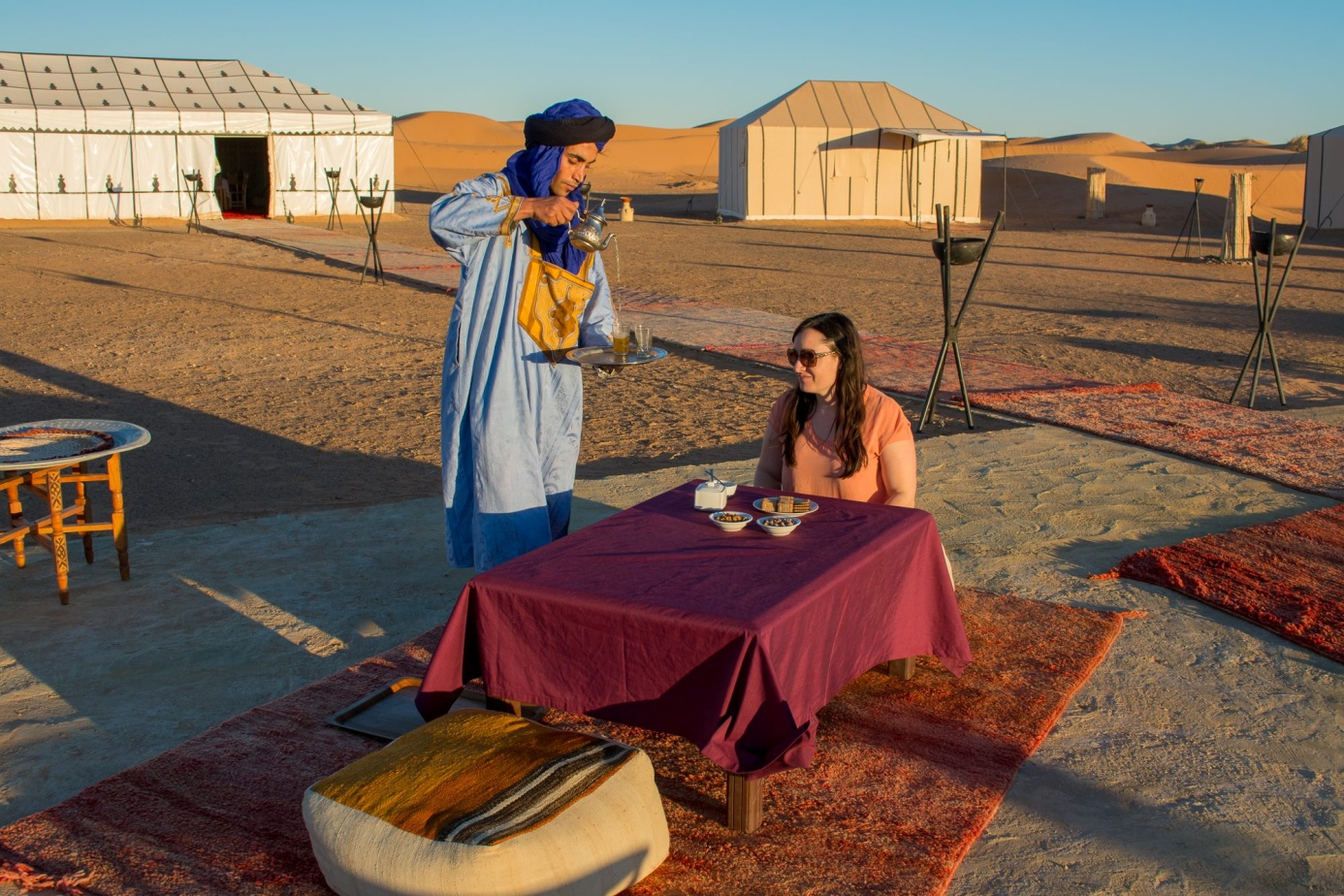
3. The Sahara Desert Gets Bitterly Cold at Night — Even in Summer
This surprises almost every single traveler I take to Merzouga.
The desert in July can reach 45°C during the day. By midnight, the same desert can drop to 10°C. The temperature swing is extreme and almost nobody is prepared for it.
Every year I watch travelers arrive at our luxury desert camp in flip flops and a t-shirt and spend half the night shivering instead of stargazing.
What to pack for the Sahara:
- A warm fleece or light down jacket
- Long trousers for the evening
- Thick socks
- A light scarf (doubles as sun protection by day and neck warmth at night)
The camps provide blankets — but an extra layer from your own bag makes the difference between a magical night and a miserable one.
4. Bargaining Is Not Rude — Refusing to Bargain Is
In Morocco’s souks and markets, the first price quoted is never the final price. This is not deception — it is a cultural tradition that both sides are expected to enjoy.
The rule of thumb I give every traveler: start at 40% of the asking price and settle somewhere around 60–70%. Always with a smile. Always with good humor. The moment it stops being fun for either side — walk away.
What NOT to do: Agree to a price, then try to renegotiate at the end. This is genuinely offensive in Moroccan culture.
What TO do: Drink the tea they offer you. Chat. Ask questions. Buy something you actually want. The interaction itself is the experience — not just the transaction.
5. The Best Moroccan Food Is Never in a Restaurant Near a Tourist Attraction
I have eaten in hundreds of restaurants across Morocco. The ones nearest to the main tourist sites are almost always the worst — overpriced, mediocre, and designed for people who won’t come back.
The best food in Morocco is found in three places:
- Small local restaurants down unmarked side streets — Look for places where the menu is written in Arabic only, where locals are eating, and where there are no photos on the menu.
- Market food stalls — The hole-in-the-wall stalls in covered markets serve freshly made msemen (Moroccan flatbread), harira soup, and kefta sandwiches that will change your understanding of street food.
- Your riad’s kitchen — Many riads offer dinner prepared by the family who runs them. Always say yes. This is almost always the best meal of any Morocco trip.
Dishes to seek out beyond tagine:
- Bastilla — Sweet and savoury pigeon pie with almonds and icing sugar. Quintessentially Moroccan.
- Mechoui — Whole slow-roasted lamb, served on Fridays in medina squares.
- Bissara — A humble fava bean soup, eaten for breakfast with argan oil and cumin. Perfect fuel for a medina morning.
- Mrouzia — A rare honey and ras el hanout lamb tagine, traditionally made for special occasions.
6. A Private Guide in Fes Is Not Optional — It Is Essential
I say this as someone who loves independent travel: do not attempt to explore Fes el-Bali alone on your first visit.
Fes has over 9,000 streets. Many have no name. The medina covers 300 hectares. Even Moroccans from other cities get lost here.
But the problem is not just navigation. Without a guide, you will walk past the most extraordinary places in the world without knowing they exist. The Al-Qarawiyyin library — the oldest in the world — is invisible from the street. The finest madrasa tilework is behind an unmarked wooden door. The best view of the Chouara tanneries requires knowing which leather shop’s terrace to climb.
A good guide in Fes does not just show you the city — they give it to you.
At Paradijom, every Fes visit includes a private expert guide. This single decision transforms the experience from confusing to unforgettable. Learn more about our private Morocco tours here.
7. One Night in the Sahara Is Never Enough
Almost every traveler who does one night in the Sahara tells me the same thing on the way back: “I wish we had stayed two nights.”
Here is the truth: one night in the Sahara is enough to experience it. Two nights is enough to feel it.
On the first night, everything is overwhelming — the scale of the dunes, the silence, the stars, the cold, the camel ride. Your senses are working overtime. By the second morning, something different happens. You slow down. You sit on the dune and watch the light change for an hour. You realize that the desert is not a backdrop — it is a presence.
My recommendation: Build a minimum of two nights in Merzouga into your itinerary. Your future self will thank you.
8. Friday Changes Everything
Friday is the holy day in Morocco. Between roughly 11:30am and 2:30pm, almost everything in the medinas shuts down for Friday prayers.
Many tourists plan busy sightseeing during this time and find themselves standing outside locked doors wondering what happened.
What to do on Friday midday:
- Have a long lunch at your riad or a rooftop restaurant
- Visit the Majorelle Garden in Marrakech (open every day)
- Rest — you are probably tired anyway
What opens on Friday: Restaurants, most hotels, tourist sites outside the medinas, and the Sahara (the desert operates on its own schedule).
9. The Hammam Is Not a Spa — and That Is Exactly the Point
Many international travelers book a hammam at a fancy hotel spa — a clean, quiet, aromatherapy-scented experience with soft music and a menu of treatments.
This is fine. But it is not a hammam.
A traditional Moroccan hammam — the neighbourhood ones that Moroccans use every week — costs between 15 and 30 dirhams ($1.50–$3). You bring your own kessa mitt and black soap or buy them outside. The room is hot, steamy, and social. People scrub each other’s backs. Children run around. It is loud and communal and unlike anything in a Western spa.
My honest advice: Do both. Do the hotel spa version first if you are nervous. Then, later in the trip, let me or your guide take you to a local neighbourhood hammam. It is one of the most authentically Moroccan experiences available to any traveler.
10. ATMs Run Out of Cash — Especially Near Tourist Sites
This catches travelers off guard constantly, particularly in smaller towns near the Sahara.
Morocco operates heavily on cash. Many riads, smaller restaurants, medina shops, and desert camps do not accept cards. And ATMs in popular tourist areas regularly run out of money — especially on weekends and during peak tourist season.
My cash strategy for Morocco:
- Withdraw enough cash in Marrakech before leaving for the desert route
- Always carry more than you think you need
- Never rely on finding a working ATM in Merzouga, Dades, or Todra
- Keep smaller bills — vendors rarely have change for large notes
11. The “Official Guide” Who Approaches You on the Street Is Not Official
In every Moroccan city, someone will approach you within minutes of entering the medina, offering to be your guide. They may say they work for the tourist office, that the medina is closed in one direction, that your hotel is full, or that the site you are looking for has moved.
Almost none of this is true.
This is not a safety issue — these individuals are rarely dangerous. But following an unofficial “guide” typically leads to a circuit of commission-paying shops, not to the authentic experiences you came for.
The simple rule: Book your guide in advance through your tour operator or hotel. A real guide carries an official government-issued card.
12. Morocco Has a Snow Season — and It Is Spectacular
Almost nobody thinks of Morocco as a destination for snow. But between December and March, the High Atlas Mountains are genuinely covered in snow — and the views are extraordinary.
The drive over the Tizi n’Tichka pass between Marrakech and Ouarzazate can be dramatic in winter, with snow on the peaks and the red kasbahs below glowing against a white backdrop.
Winter Morocco tips:
- The Sahara Desert is actually beautiful in winter — cooler days make the dune walks more comfortable
- Marrakech and Fes are pleasant in winter — cool but rarely cold in the cities
- The Atlas Mountain roads can occasionally close in heavy snow — build flexibility into your itinerary
13. Argan Oil Is Morocco’s Liquid Gold — But Most of What Is Sold to Tourists Is Fake
Morocco produces the world’s finest argan oil — pressed from the nuts of the argan tree, found only in a specific region of southwest Morocco. Real argan oil is extraordinary: for cooking, for skin, for hair.
But the argan oil cooperatives near major tourist roads frequently sell diluted or entirely fake products to tour groups brought by commission-paying drivers.
How to buy real argan oil:
- Buy from a women’s cooperative with official certification
- The price for genuine culinary argan oil is around 250–350 dirhams per litre ($25–35)
- If it costs less than this — it is diluted
- Real cosmetic argan oil is lighter in color and has a distinctive nutty smell
At Paradijom, we take our clients to certified cooperatives only. See our tailor-made Morocco tours for details.
14. The Most Beautiful Drive in Morocco Is One Nobody Talks About
Everyone knows the Tizi n’Tichka pass. Fewer people know the Draa Valley route from Ouarzazate south toward Zagora.
This road runs through 200 kilometres of date palm oases, ancient kasbahs, Berber villages, and dramatic desert landscapes. The Valley of a Thousand Kasbahs deserves its name — every hilltop has a crumbling mud-brick fortress, every bend in the road reveals a new extraordinary view.
Other underrated drives:
- Dades Gorge to Todra Gorge — 2 hours of increasingly dramatic canyon scenery
- Chefchaouen to Fes via Azrou — Cedar forests, Barbary macaques, and mountain villages
- Taroudant to Tiznit — The undiscovered south, completely off the tourist circuit
Morocco is a country best experienced at road level. The distances between cities are long — but the journey is always worth every kilometre.
15. Morocco Will Make You Want to Come Back — Plan for It
I have never guided a traveler through Morocco who left saying “that was enough.”
The ones who did 7 days come back for 14. The ones who saw the north come back for the south. The ones who loved the desert come back for the mountains. The ones who came in spring come back in winter.
Morocco is not a destination you check off a list. It is a country that gets into you — slowly, quietly, completely.
My advice: Before you book your first Morocco trip, mentally plan your second one. The first visit is to fall in love. The second is to go deeper.
How to Use These Tips
If you are planning your first Morocco trip, these 15 tips will help you avoid the mistakes that turn a good holiday into a forgettable one.
But the single biggest tip I can give — the one that changes everything — is this: travel privately, with a local guide who genuinely loves their country.
The difference between a group tour and a private Morocco experience is not about comfort. It is about access, pace, and depth. A private guide takes you to the restaurant nobody else knows about. They introduce you to the craftsman who learned his art from his grandfather. They know when to speak and when to let the silence do its work.
At Paradijom, we have been creating these private Morocco experiences for over 8 years. Every trip is completely tailor-made — no group buses, no fixed schedules, no strangers.
Ready to plan your Morocco trip?
👉 Browse our custom Morocco tours 👉 Explore our Morocco honeymoon packages 👉 Read our complete 7-day Morocco itinerary 👉 Contact Ben directly
Did We Miss Anything?
Have you visited Morocco and discovered something that surprised you? Or do you have a question about planning your trip?
Leave a comment below — Ben and the Paradijom team read and personally reply to every single comment. Your question might become tip number 16! 👇
Ben Khalid is the founder of Paradijom, a luxury private Morocco tour agency based in Marrakech. Born near the Sahara Desert, he has been designing tailor-made Morocco experiences for international travelers for over 8 years. Contact: info@paradijom.com | WhatsApp: +212 663 498 126
